Have you been diagnosed with an immature cataract and wondered whether you need surgery immediately or can wait? Or has your eye doctor mentioned a mature cataract, leaving you concerned about how much your vision may have deteriorated?
Although both conditions involve clouding of the eye’s natural lens, they differ in the extent of cloudiness, their effect on vision and the approach to treatment. An immature cataract affects only part of the lens, while a mature cataract involves complete clouding.
But here’s something important: you do not need to wait for an immature cataract to become mature before considering surgery. The right time for treatment depends on how your vision is affected, your daily activities and your ophthalmologist’s assessment.
In this guide, we’ll explain the difference between mature and immature cataracts, their symptoms, how they are diagnosed, available treatment options and when to consider an eye examination.
What Is an Immature Cataract?
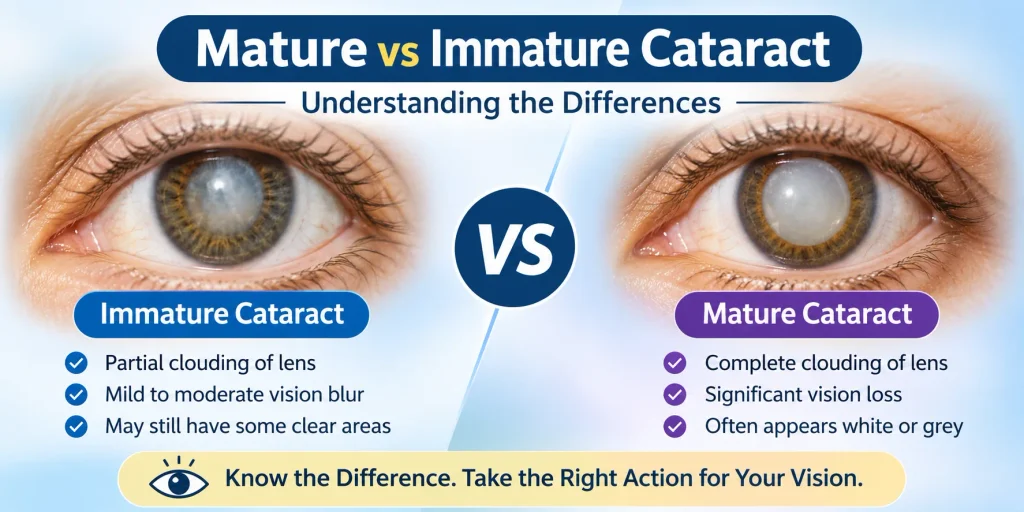
An immature cataract is an early or developing stage in which only part of the eye’s natural lens has become cloudy. Some clear areas remain, allowing light to pass through, although vision may gradually become blurred or less sharp.
At this stage, the changes may be mild and can sometimes be managed with an updated glasses prescription, better lighting and regular eye examinations. However, the cataract can continue to progress over time.
Common symptoms of an immature cataract include:
- Blurred or hazy vision
- Difficulty reading in dim light
- Increased sensitivity to bright lights
- Glare or halos around headlights
- Colours appearing less bright
- Frequent changes in glasses prescription
Symptoms vary depending on the location and type of cataract. Some people may notice significant glare even when the cataract is still at an early stage.
Cataracts are a major cause of vision impairment worldwide. According to the World Health Organization (WHO), around 94 million people globally have cataract-related distance vision impairment or blindness. This highlights the importance of regular eye examinations, particularly because cataracts can develop gradually without causing noticeable problems in their early stages.
What Is a Mature Cataract?
A mature cataract is an advanced stage in which the entire natural lens has become opaque, preventing light from passing through it clearly. Vision is usually significantly reduced, and the affected eye may have difficulty recognising objects or seeing details.
In some cases, the pupil may appear white or grey because of the cloudy lens behind it. A mature cataract can interfere with everyday activities such as reading, walking, recognising faces and watching television.
Common symptoms of a mature cataract include:
- Severe or persistent blurred vision
- Significant difficulty seeing in low light
- Poor recognition of faces and objects
- Reduced ability to perform daily activities
- A white or grey appearance behind the pupil in some cases
- Very limited vision in the affected eye
A mature cataract requires an ophthalmologist’s assessment. Cataract surgery is the only treatment that removes the cloudy natural lens.
Mature vs Immature Cataract: What Is the Difference?
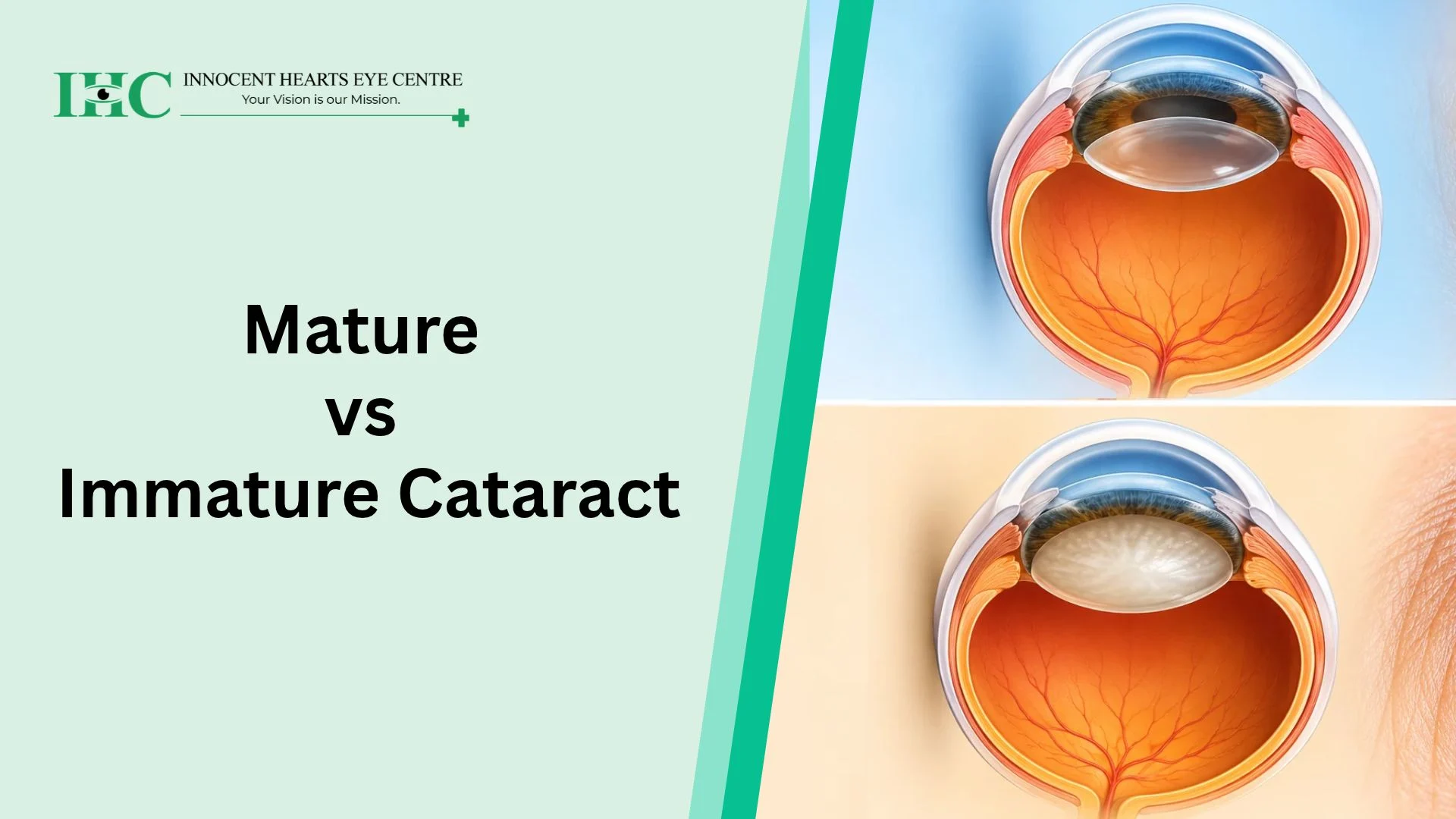
The main difference is how much of the natural lens has become cloudy. An immature cataract has partial clouding, while a mature cataract involves complete clouding of the lens.
| Feature | Immature Cataract | Mature Cataract |
| Stage | Developing or early stage | Advanced stage |
| Lens opacity | Partial clouding | Entire lens is opaque |
| Vision | Mild to moderate blurring, depending on the cataract | Usually severe vision reduction |
| Light transmission | Some light can pass through | Light transmission is significantly blocked |
| Daily activities | May still be manageable | Often affected considerably |
| Pupil appearance | Usually retains its normal dark appearance | May appear white or grey |
| Iris shadow test | Usually present | Usually absent |
| Treatment | Monitoring or surgery, depending on symptoms | Surgery is generally required when the cataract causes significant visual impairment |
What is the iris shadow test?
The iris shadow test is a clinical method that may help an eye specialist distinguish between an immature and a mature cataract. When light is directed at the eye, an immature cataract may allow a shadow of the iris to appear on the cloudy lens because some parts of the lens remain relatively clear.
In a mature cataract, the lens is completely opaque, so this shadow is generally absent. The test is only one part of an eye examination and should not be used for self-diagnosis.

How Is an Immature or Mature Cataract Diagnosed?
An ophthalmologist can identify the cataract stage through a comprehensive eye examination. The assessment helps determine how much the lens is clouded and whether other eye conditions may also be affecting vision.
Common tests include:
- Visual acuity test: Measures how clearly you can see at different distances.
- Slit-lamp examination: Allows the specialist to examine the lens and identify the extent of clouding.
- Dilated eye examination: Helps assess the retina and other structures at the back of the eye.
- Iris shadow assessment: May help distinguish between immature and mature cataracts.
- B-scan ultrasonography: May be used when a dense cataract prevents the doctor from examining the retina directly.
The doctor may also check eye pressure and assess the overall health of the eye before recommending treatment.
The importance of early detection is reflected in Indian research. A 2025 study published in the Indian Journal of Ophthalmology, using data from the National Blindness and Visual Impairment Survey (2015–2018), found that cataract-associated visual impairment affected an estimated 12.9% of people aged 50 and above at a visual acuity threshold worse than 6/12. At a more severe threshold, worse than 3/60, the prevalence was 3.0%. These findings reinforce the value of regular eye examinations, particularly among older adults.
Does an Immature Cataract Need Surgery?
Not necessarily. An immature cataract does not always require immediate surgery. If vision is still good enough for everyday activities, the ophthalmologist may recommend regular monitoring.
For early cataracts, some practical measures may help manage symptoms:
- Updating your glasses prescription
- Using brighter lighting while reading
- Wearing anti-glare sunglasses outdoors
- Using magnifying lenses when needed
- Attending regular eye examinations
However, these measures do not remove or reverse the cataract. Surgery may be recommended when blurred vision, glare or other symptoms begin to interfere with activities such as reading, driving, working or recognising faces.
The decision is based on how much the cataract affects your vision, your eye health and your daily needs—not simply on whether it is labelled immature or mature.
What Are the Treatment Options for Mature and Immature Cataracts?
Cataract treatment depends on the stage of the condition and its effect on vision.
For an immature cataract
If the cataract is not significantly affecting daily activities, the doctor may recommend observation and periodic eye examinations. Updated spectacles and better lighting may improve visual comfort temporarily.
If vision becomes troublesome, cataract surgery can be considered even before the cataract becomes mature. There is no need to wait for complete clouding if the cataract is already affecting your quality of life.
For a mature cataract
When a mature cataract causes substantial vision loss, surgery is generally recommended after an eye specialist evaluates the patient. The cloudy natural lens is removed and replaced with an artificial intraocular lens (IOL).
Two commonly used surgical techniques are:
- Phacoemulsification: A small-incision technique that uses ultrasound energy to break up and remove the cloudy lens before an artificial lens is implanted.
- Manual Small Incision Cataract Surgery (MSICS): A technique in which the cataract is removed through a small incision, often considered for denser cataracts or when clinically appropriate.
The choice of procedure depends on the cataract, the condition of the eye and the surgeon’s assessment.
Surgery can improve vision in people with advanced cataracts. In a 2024 study involving 46 patients with white mature cataracts, 80.43% achieved postoperative vision between 6/6 and 6/9 within 30 days. However, intraoperative complications were also reported, showing why careful examination and surgical planning are important. The outcome of surgery varies depending on retinal health, other eye conditions and the patient’s overall eye health.
Access to treatment is also an important concern. The WHO reports that around one in two people who need cataract surgery worldwide do not have access to it, highlighting the importance of timely diagnosis and appropriate treatment.
When Should You Visit an Eye Specialist?
Do not wait for a cataract to become mature before getting your eyes examined. Arrange an eye examination if you notice persistent blurred vision, increasing glare, difficulty reading or trouble performing routine activities.
Seek prompt medical attention if you experience sudden vision loss, severe eye pain, marked redness or other sudden changes in your vision. These symptoms should not automatically be attributed to cataracts.
Regular eye examinations are particularly important for older adults and people with diabetes or other conditions that can affect eye health.
Get Your Cataracts Examined at Innocent Hearts Eye Centre
Whether you have an immature cataract or an advanced mature cataract, an eye examination can help determine the condition of your lens and the most appropriate treatment.
At Innocent Hearts Eye Centre, a comprehensive eye assessment can help you understand your cataract stage and discuss suitable treatment options with an eye specialist.
If you have noticed blurred vision, glare or difficulty with everyday activities, schedule an eye examination rather than waiting for your symptoms to worsen.
References and Further Reading
- World Health Organization (2026): Blindness and Vision Impairment.
- Gupta V. et al. (2025). Visual impairment due to cataract and barriers to accessing cataract surgical services in Indian populations aged 50+ years. Indian Journal of Ophthalmology.
- Jaiswal K. et al. (2024). Visual Outcome and Complications in White Mature Cataracts after Phacoemulsification. Middle East African Journal of Ophthalmology.
- American Academy of Ophthalmology. Does the time come when a person waits too long to have a cataract removed?.
- National Eye Institute – Cataracts.
Don’t ignore mature cataracts. Treat them in time and protect your vision.
Also Read
- मोतियाबिंद सर्जरी का सही समय: लक्षण, मिथक और विशेषज्ञ सलाह
- आँखों में लाल धब्बों के कारणों की अनदेखी कैसे महंगी पड़ सकती है
- Types of Cataract Lenses: A Complete Guide to Choosing the Right Lens for Your Eyes
- What is Cataract and how is it treated?
- What is the Difference Between Cataract and Glaucoma?
- SMILE Pro Eye Surgery for Astigmatism
- Myths and Misconceptions About SMILE Pro Eye Surgery
- Understanding Smile Pro Eye Surgery
- 10 Natural Ways to Improve Your Vision – Bye Bye Glasses!
- Comparing Smile Pro Eye Surgery to Other LASIK Procedures
Google Map
Frequently Asked Questions
An immature cataract involves partial clouding of the natural lens, while a mature cataract involves complete clouding. Vision is generally more severely affected in a mature cataract.
An immature cataract may be monitored if it is not significantly affecting vision. Updated glasses, better lighting and anti-glare sunglasses can help manage some symptoms, but they cannot remove the cataract.
An immature cataract can progress over time, but the rate of progression varies. Regular eye examinations help the ophthalmologist monitor changes and advise when treatment may be needed.
An iris shadow is a shadow that may appear on the cloudy lens during an eye examination. It is generally present in an immature cataract because some parts of the lens remain clear, but it is usually absent in a mature cataract.
A dense or mature cataract can require more careful surgical planning and technique. However, successful surgery is possible in many cases. The appropriate approach depends on the cataract and the health of the eye.