
Growing older comes with certain changes we can’t avoid: gray hair, wrinkles, and yes, some shifts in our vision. Most people expect that they’ll eventually need reading glasses or find night driving harder. But here’s the thing, not every change is just “normal ageing.” Some symptoms could point toward cataracts, one of the most common but treatable eye conditions.
At Innocent Hearts Eye Centre (IHEC), Jalandhar, we often meet patients who assume their vision issues are simply part of getting older. By the time they come in, their cataracts have already started interfering with daily life. The key is knowing when to watch, and when to seek medical attention. When it comes to vision changes, the big question is always Cataracts vs Normal Aging Eyes—and knowing the difference can save you from years of unnecessary struggle.
📞 Book your appointment now via WhatsApp at +91-9875969672 or visit our website to schedule an in-person consultation.
Let’s break down how to tell the difference between normal age-related changes and cataracts, and why getting the right diagnosis matters.
What Happens to Eyes as We Age?
Ageing doesn’t automatically mean disease. Many changes in vision are expected, slow, and usually manageable. Here are some common ones:
1. Presbyopia
This is probably the first age-related change you’ll notice, often in your early 40s. Suddenly, reading a text message requires stretching your arm out to find the “clear” zone. That’s presbyopia, your eye’s lens loses its flexibility and can’t focus on nearby objects as easily. The solution is usually simple: reading glasses, bifocals, or progressive lenses.
2. Slight Yellowing of the Lens
With time, the natural lens of your eye can develop a faint yellowish tint. Colors may not look as crisp as before. Whites may seem off-white, and blue tones may appear muted. This process is gradual and rarely disruptive to daily life in its early stages.
3. Reduced Pupil Response
As the muscles controlling your pupils weaken, your eyes don’t adjust to changes in light as quickly. You might notice it’s harder to see after stepping into a dark room, or headlights at night feel more glaring. It’s a natural change, but worth noting.
4. Floaters
Those small dots, threads, or cobweb-like shapes drifting across your vision are called floaters. They are caused by natural changes in the vitreous gel inside your eye. Most of the time, they’re harmless, but a sudden increase in floaters can signal a retinal issue, which needs urgent attention.
These changes happen slowly, and most people adapt. A new pair of glasses, brighter lighting, or lifestyle tweaks are often enough to manage them.
What Is a Cataract?
Now, let’s talk about cataracts, which are not just a normal part of ageing, though they’re strongly age-related.
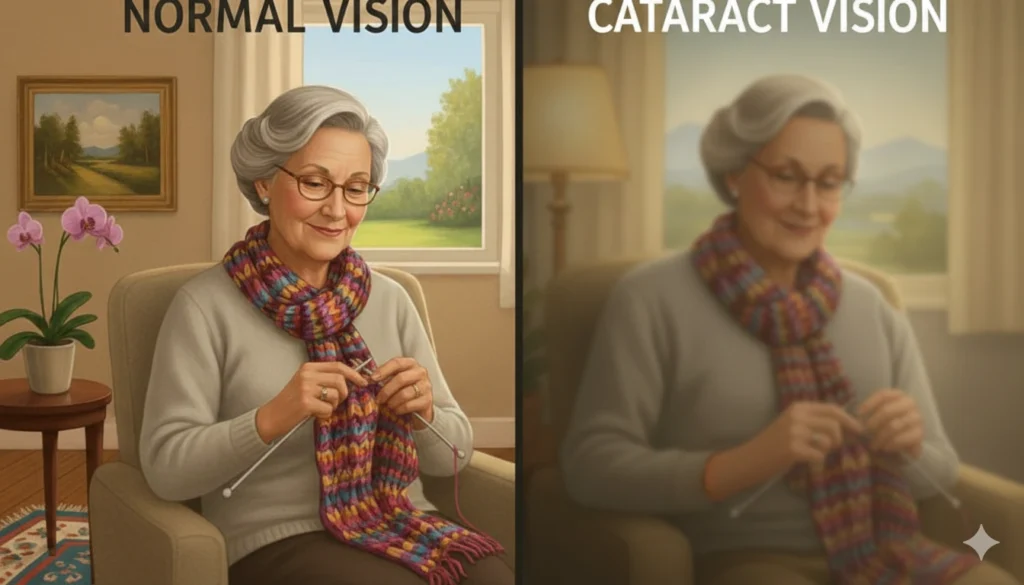
A cataract is when the proteins in the eye’s natural lens break down and clump together, making the lens cloudy. Instead of light passing cleanly through, it gets scattered. The result is blurred, foggy, or dim vision that feels like looking through a smudged window.
Unlike presbyopia or mild yellowing, cataracts are progressive. They don’t just plateau, they gradually worsen until daily activities like reading, driving, or recognizing faces become difficult. The only permanent treatment is surgery, a safe and highly successful procedure performed routinely at IHEC, Jalandhar.

Key Differences: Cataracts vs Normal Aging Eyes
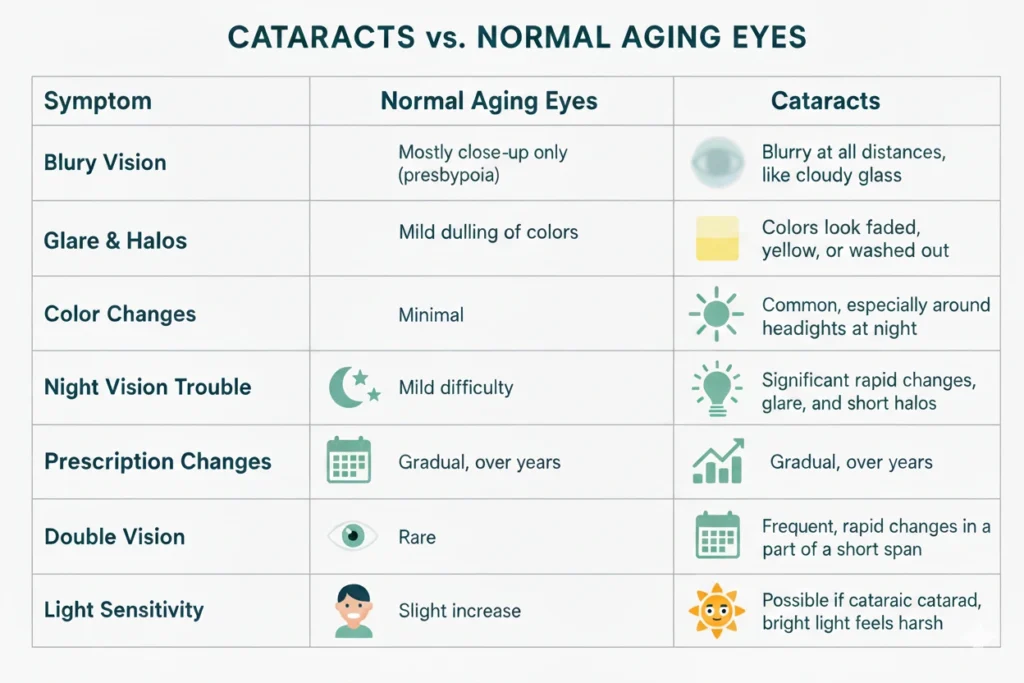
Understanding Cataracts vs Normal Aging Eyes is crucial, because while ageing brings gradual and manageable changes, cataracts progress and require timely treatment. It can be tricky to tell the two apart without an eye exam, but here’s a comparison that helps:
| Symptom | Normal Ageing | Cataract |
| Blurry Vision | Mostly close-up only (presbyopia) | Blurry at all distances, like cloudy glass |
| Color Changes | Mild dulling of colors | Colors look faded, yellow, or washed out |
| Glare & Halos | Minimal | Common, especially around headlights at night |
| Night Vision Trouble | Mild difficulty | Significant issues, glare, and halos |
| Prescription Changes | Gradual, over years | Frequent, rapid changes in a short span |
| Double Vision | Rare | Possible if cataract clouds one part of the lens |
| Light Sensitivity | Slight increase | Often pronounced, bright light feels harsh |
If you’re ticking off multiple cataract symptoms like glare, faded colors, and worsening night vision, it’s time to get checked.
Other Eye Conditions to Rule Out
Not all vision changes point to cataracts or ageing. Some serious eye diseases mimic similar symptoms and must be ruled out:
- Glaucoma: Often painless, but causes irreversible vision loss starting with side (peripheral) vision. Regular pressure checks are essential.
- Macular Degeneration: Damages central vision, so reading or recognizing faces becomes difficult.
- Diabetic Retinopathy: Caused by damage to blood vessels in the retina, often linked to uncontrolled diabetes.
At IHEC, our doctors use advanced diagnostic tools to catch these conditions early, when treatment is most effective.
How Eye Doctors Tell the Difference
So how do ophthalmologists separate normal ageing from cataracts? At IHEC, a comprehensive eye exam usually includes:
- Visual acuity testing (the classic eye chart)
- Slit-lamp examination to check for lens clouding
- Dilated eye exam to see the retina clearly
- Glare and contrast sensitivity tests to measure how cataracts affect functional vision
- Eye pressure measurement to screen for glaucoma
These tests are painless, quick, and give clear answers.
Explore Laser Cataract Surgery at IHEC:- https://innocentheartseyecentre.com/lasik-eye-surgery-jalandhar/
When Is Cataract Treatment Needed?
Not every cataract requires immediate surgery. In the early stages, vision might still be manageable with:
- Updated glasses prescriptions
- Anti-glare coatings
- Brighter home or office lighting
- Magnifying aids for reading
But when vision problems start interfering with daily life, reading, driving, cooking, or even recognizing faces, that’s when surgery becomes the best option.
At Innocent Hearts Eye Centre, Jalandhar, cataract surgery is performed using advanced technology and minimally invasive techniques. The cloudy lens is replaced with a clear, artificial intraocular lens (IOL), customized to your needs. Most patients see a dramatic improvement in vision within days.
📞 Book your appointment now via WhatsApp at +91-9875969672 or visit our website to schedule an in-person consultation.
Why IHEC Is Trusted for Cataract Care
At Innocent Hearts Eye Centre, Jalandhar, we help patients clearly understand Cataracts vs Normal Aging Eyes, so they know when it’s time for expert care with Dr. Rohan Bowry. Here’s what sets IHEC, Jalandhar apart:
- Experienced team led by Dr. Rohan Bowry, one of Punjab’s most trusted eye surgeons.
- State-of-the-art ZEISS technology for accurate diagnosis and precision surgery.
- Customized lens options, from monofocal to premium multifocal and toric IOLs, so every patient gets the best fit.
- Proven track record of safe, successful outcomes with compassionate care.
Many patients come to us after struggling for months or years, thinking vision decline is just “old age.” After surgery, they often say, “I wish I hadn’t waited this long.”
Real Patients, Real Reviews
Final Thoughts: Don’t Just “Wait It Out”
It’s tempting to brush off blurry or dim vision as “just getting older.” But here’s the truth, early detection makes all the difference. Cataracts are treatable, and surgery today is safer and more effective than ever.If you’re unsure whether your symptoms are normal ageing or cataracts, don’t guess. Book a comprehensive eye exam at Innocent Hearts Eye Centre, Jalandhar. Your future self will thank you.
📞 Call us at +91-98759 69672
🌐 Visit https://innocentheartseyecentre.com
📍 Book your appointment at our Jalandhar Centre
Google Map
Also Read
- What is Cataract and how is it treated?
- Types of Cataract Lenses: A Complete Guide to Choosing the Right Lens for Your Eyes
- Understanding Smile Pro Eye Surgery
- Types of Cataract Surgery: Procedures, Benefits & Choosing the Right One for You
- Comparing Smile Pro Eye Surgery to Other LASIK Procedures
- मोतियाबिंद सर्जरी का सही समय: लक्षण, मिथक और विशेषज्ञ सलाह
- Understanding Presbyopia: Causes, Symptoms, Diagnosis, and Advanced Treatments
- PRESBYOND Laser Blended Vision At Innocent Hearts Eye Centre
- Punjab’s First ZEISS Refractive Suite Now at Innocent Hearts Eye Hospital, Jalandhar
- What to Eat After Cataract Surgery?
- What Happens When Cataract Matures?
- आँखों में लाल धब्बों के कारणों की अनदेखी कैसे महंगी पड़ सकती है
- What is the Difference Between Cataract and Glaucoma?
- SMILE Pro Eye Surgery for Astigmatism
- Myths and Misconceptions About SMILE Pro Eye Surgery
- 10 Natural Ways to Improve Your Vision – Bye Bye Glasses!
Frequently Asked Questions About Cataracts vs Normal Aging Eyes (FAQ
A healthy eye sees clearly with normal color perception and minimal glare. A cataract eye often looks cloudy, with blurred or dim vision, faded colors, trouble seeing at night, and increased glare.
A mature cataract causes major vision problems—reading, driving, or recognizing faces becomes difficult. The lens becomes fully opaque, and surgery is usually advised.
Watch for blurry vision, glare or halos, faded colors, difficulty reading, and frequent prescription changes. A full eye exam at IHEC confirms the diagnosis.
You may notice foggy or blurry vision, glare, or dull colors. Night vision trouble is another early sign. But only an eye specialist can confirm cataracts.
They usually begin after 40, but symptoms often appear in the 50s or 60s. Diabetes, smoking, and UV exposure can speed up their development.